
Description
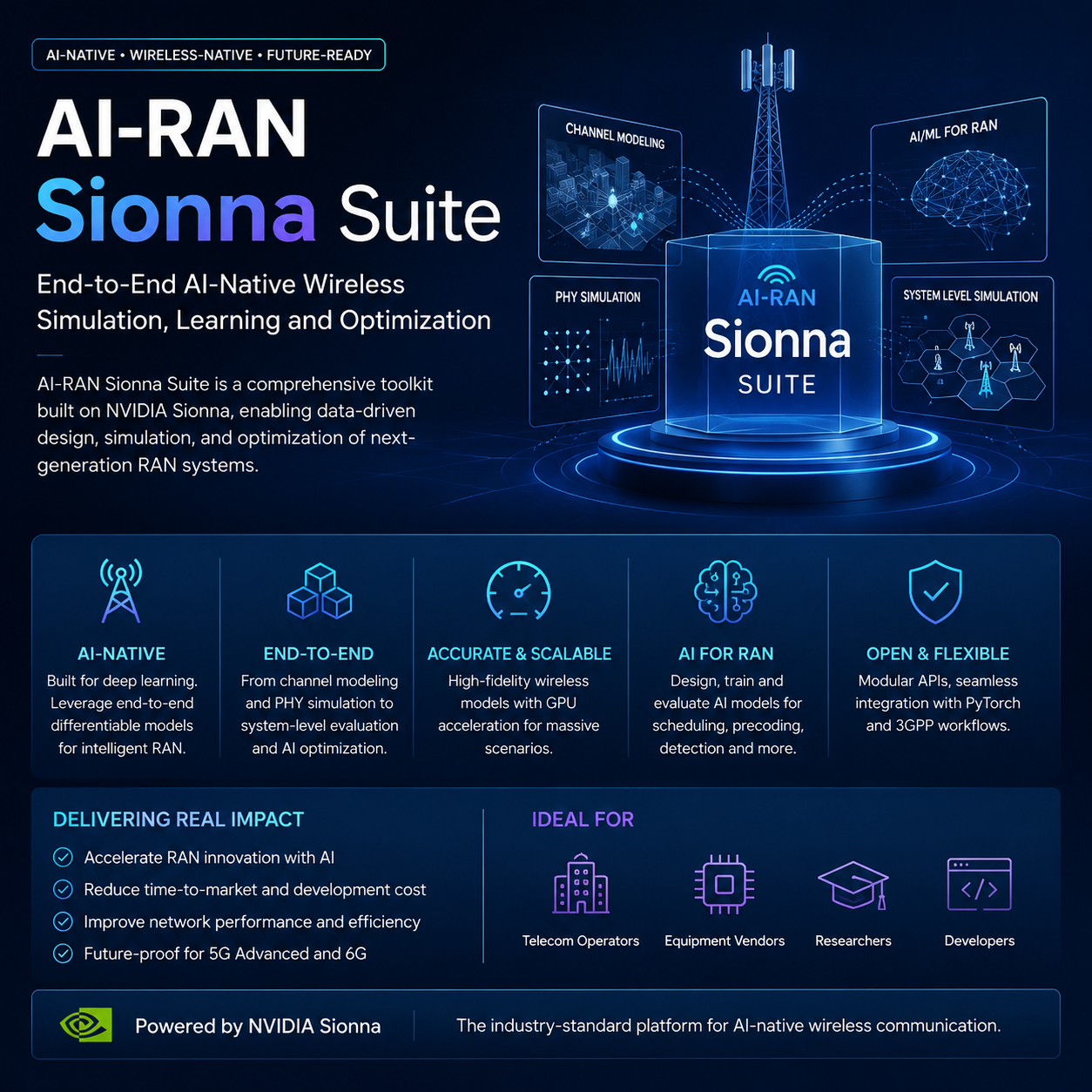
AI-RAN Sionna Wireless Communications R&D and Validation Platform
1. Solution Overview
The AI-RAN Sionna Wireless Communications R&D and Validation Platform is a complete hardware-and-software research environment designed with reference to the NVIDIA Sionna Research Kit architecture. It is intended for advanced research and development in 5G, 6G, AI-RAN, and AI-native physical-layer technologies.
The platform uses NVIDIA DGX Spark as the primary computing node and integrates NVIDIA Sionna, OpenAirInterface, CUDA, TensorRT, software-defined radio equipment, and a complete 5G Core network. It supports the full workflow from communication-system simulation and AI model training to real-time inference, over-the-air deployment, and wireless performance validation.
A complete software-defined 5G RAN and 5G Core can run on a single computing platform. Researchers can develop and evaluate algorithms through software simulation, RF cable-connected testing, or over-the-air experiments.
The platform addresses a common limitation in conventional wireless research: algorithms developed in simulation are often difficult to deploy in a real-time communication system. With this solution, researchers can first perform channel modeling, link-level simulation, and neural-network training in Sionna, export the trained model to TensorRT, and then integrate it directly into a real-time 5G NR base station.
Typical research areas include:
- Neural receivers
- Neural demappers
- AI-assisted channel estimation
- Link adaptation
- AI-RAN optimization
- Digital twin-based wireless testing
- Intelligent radio resource management
- GPU-accelerated physical-layer processing
The platform is suitable for universities, research institutes, telecom laboratories, operators, and wireless equipment development teams.
Typical applications include:
- 5G and 6G physical-layer algorithm research
- AI-RAN and AI-native RAN prototyping
- Neural receiver and neural demapper development
- OpenAirInterface and software-defined radio education
- Wireless digital twin development
- Real-time channel emulation
- O-RAN, RIC, and xApp research
- Wireless data acquisition and AI model training
- End-to-end AI model deployment and validation
2. Hardware Configuration
2.1 AI-RAN Computing Platform
The recommended computing platform is NVIDIA DGX Spark, powered by the NVIDIA GB10 Grace Blackwell Superchip.
The system integrates an Arm-based CPU, Blackwell GPU, Tensor Cores, RT Cores, high-speed networking, and a unified CPU-GPU memory architecture.
Key specifications include:
- 20-core Arm CPU
- NVIDIA Blackwell architecture GPU
- Fifth-generation Tensor Cores
- Fourth-generation RT Cores
- Up to 1 PFLOP of FP4 AI computing performance
- 128 GB LPDDR5X coherent unified memory
- 273 GB/s memory bandwidth
- 4 TB NVMe SSD
- ConnectX-7 high-speed network interface
- Up to 200 Gbps network connectivity
- NVIDIA DGX OS
- CUDA development environment
- TensorRT inference environment
- NVIDIA AI software stack
The unified memory architecture reduces unnecessary data transfers between the CPU and GPU. This is particularly suitable for low-latency physical-layer acceleration, real-time AI inference, signal processing, and wireless channel simulation.
In addition to DGX Spark, the platform can also be configured with NVIDIA Jetson AGX Thor or compatible Jetson AGX Orin systems for embedded and edge-oriented research.
2.2 Software-Defined Radio
The software-defined radio can be selected according to the required bandwidth, MIMO configuration, and experimental complexity.
Standard Research Configuration: USRP B210
The USRP B210 is suitable for general 5G NR research, communication laboratories, teaching, and compact AI-RAN validation systems.
Main specifications include:
- Two transmit channels
- Two receive channels
- Full-duplex operation
- 2×2 MIMO support
- Frequency range from 70 MHz to 6 GHz
- Up to 56 MHz of real-time instantaneous bandwidth
- USB 3.0 high-speed interface
- Up to 61.44 MS/s complex sample streaming
- Support for Sub-6 GHz wireless experiments
The USRP B205mini and B206mini may also be used for single-channel experiments, although they do not provide the same full 2×2 MIMO capability as the B210.
High-Performance Configuration: USRP X410
The USRP X410 is recommended for wideband, multi-channel, and higher-performance 5G and 6G research.
Main specifications include:
- Four transmit channels
- Four receive channels
- Full-duplex operation
- Up to 400 MHz instantaneous bandwidth per channel
- Frequency coverage from approximately 1 MHz to 7.2 GHz
- Extended tuning capability up to approximately 8 GHz
- Zynq UltraScale+ RFSoC architecture
- 100 GbE connectivity
- Direct connection to the DGX Spark ConnectX-7 interface
- Support for wideband waveform development
- Support for multi-channel MIMO research
- Support for high-throughput signal processing
The X410 configuration is particularly suitable for advanced 5G, 6G, wideband MIMO, AI-native air interface, and real-time channel-processing experiments.
2.3 5G User Equipment
A standard commercial user equipment configuration may include:
- Quectel RM520N-GL 5G communication module
- M.2-to-USB 3.0 adapter
- Ubuntu control computer
- Programmable SIM card
- SIM card reader and writer
- RF cables and attenuators
- Optional commercial 5G CPE
- Optional industrial 5G modem
- Optional commercial smartphone or test terminal
Commercial off-the-shelf 5G devices may connect to the software-defined 5G network through an RF cable or an over-the-air radio link.
2.4 RF and Test Accessories
The platform can be supplied with the following RF and laboratory accessories:
- SMA RF cables
- RF combiners
- RF splitters
- 20 dB attenuators
- 40 dB attenuators
- Sub-6 GHz antennas
- RF shield box
- Programmable SIM cards
- SIM card programmer
- Optional spectrum analyzer
- Optional 10 MHz reference clock
- Optional 1 PPS timing reference
- Optional GPS-disciplined oscillator
- Optional QSFP28 100 GbE cable for USRP X410
For RF cable-connected testing, appropriate attenuation must be installed between the USRP and the user terminal to prevent damage to the RF front ends.
2.5 Optional Software-Defined User Equipment
A second USRP B210 can be combined with an NVIDIA Jetson Orin Nano Super, Jetson AGX Orin, Jetson AGX Thor, or another compatible computing node to build a fully software-defined 5G user equipment platform.
This configuration provides access to both the base-station and user-equipment protocol stacks.
It is suitable for research in:
- Non-standard waveforms
- AI-native transceivers
- End-to-end learned communication systems
- Joint transmitter and receiver optimization
- Experimental 6G protocols
- Custom synchronization algorithms
- Advanced channel estimation
- New modulation and coding techniques
3. Core Functions
3.1 End-to-End Real-Time 5G Network
The platform integrates the OpenAirInterface 5G NR gNodeB and a complete 5G Core network.
Core network functions may include:
- Access and Mobility Management Function
- Session Management Function
- User Plane Function
- Data Network services
- Subscriber database and authentication functions
The platform supports:
- 5G SA standalone networking
- Registration of commercial 5G modules
- End-to-end data services
- RF Simulator-based software testing
- RF cable-connected testing
- Shielded over-the-air testing
- Ping connectivity testing
- iperf3 throughput testing
- Protocol procedure monitoring
- Base-station log analysis
- Core-network log analysis
- CPU, GPU, and memory monitoring
A private software-defined 5G network can be deployed on the platform without requiring conventional proprietary base-station hardware.
3.2 Sionna Link-Level and System-Level Simulation
The platform integrates Sionna PHY and Sionna SYS for GPU-accelerated communication-system simulation.
Supported research areas include:
- 5G NR uplink simulation
- 5G NR downlink simulation
- OFDM waveform processing
- MIMO communication systems
- Channel coding
- LDPC encoding and decoding
- Modulation and demodulation
- Soft-bit and LLR calculation
- Channel estimation
- Signal equalization
- BER evaluation
- BLER evaluation
- Throughput analysis
- Spectral-efficiency analysis
- Link adaptation
- AI- and machine-learning-based communication algorithms
Sionna provides modular Python interfaces that allow communication-system components to be assembled in a manner similar to neural-network layers.
It also supports differentiable communication-system design, enabling gradients to propagate through communication modules during model training.
3.3 GPU-Accelerated Physical Layer
The platform supports CUDA-based acceleration of 5G NR physical-layer modules.
For example, computationally intensive functions such as LDPC decoding can be migrated from the CPU to the GPU.
The unified memory architecture of DGX Spark supports inline acceleration, allowing baseband data to be processed directly by GPU-based functions without excessive memory transfers across a conventional PCIe-connected CPU-GPU architecture.
Supported development areas include:
- GPU-accelerated LDPC decoding
- CUDA-based channel estimation
- GPU-based equalization
- GPU soft demapping
- LLR generation
- CUDA Graph-based processing pipelines
- Parallel signal processing
- Custom CUDA physical-layer functions
- AI and machine-learning physical-layer operators
The platform provides access to CUDA development tools and interfaces, allowing researchers to develop custom accelerated communication algorithms.
3.4 Neural Demapper
The platform supports the complete development and deployment process for neural demappers.
Researchers can:
- Design neural-network models in Sionna
- Generate training data through simulation
- Train the model using simulated channel data
- Train the model using real RF data
- Export the trained model
- Convert the model into a TensorRT engine
- Deploy the TensorRT engine in OpenAirInterface
- Integrate the neural model into the PUSCH processing chain
- Compare neural and conventional demappers
- Measure BLER performance
- Evaluate inference latency
- Analyze GPU utilization
TensorRT and Tensor Cores can be used to accelerate the neural model, while CUDA Graphs can reduce kernel-launch overhead and improve deterministic execution.
3.5 5G NR PUSCH Neural Receiver
The platform supports the development of a neural receiver for the 5G NR Physical Uplink Shared Channel.
The neural receiver can replace or assist conventional receiver functions such as:
- Channel estimation
- Signal equalization
- Soft demapping
- Noise estimation
- Interference mitigation
Main capabilities include:
- Joint neural channel estimation and equalization
- Neural soft-bit generation
- Tensor Core-accelerated inference
- CUDA-based preprocessing
- CUDA-based post-processing
- Unified-memory data exchange
- Low-copy or zero-copy processing
- Real-time integration with a 5G NR network
- Comparison with a conventional receiver
- Evaluation under real wireless channels
- Evaluation under RF hardware impairments
The neural receiver can be trained in simulation and subsequently fine-tuned or validated using real radio data.
3.6 Real-Time Channel Emulation and Wireless Digital Twin
The platform can use Sionna RT, GPU RT Cores, and CUDA Cores to create a real-time wireless channel emulator.
RT Cores calculate radio propagation paths and channel characteristics in a three-dimensional environment. CUDA Cores then apply the time-varying channel response to real-time baseband signals.
A commercial 5G terminal can be connected through RF cables and experience a dynamically generated wireless channel without transmitting radio signals into the surrounding environment.
Supported functions include:
- Import of 3D building models
- Import of city-scale environments
- Reflection modeling
- Diffraction modeling
- Scattering modeling
- Multipath propagation analysis
- Time-varying channel impulse response
- Mobile user trajectory simulation
- Real-time channel convolution
- Wireless coverage-map generation
- Radio-map generation
- Digital twin-based neural receiver testing
- Dynamic link-condition simulation
This capability allows repeatable and controllable testing of wireless algorithms in virtual environments that represent realistic physical spaces.
3.7 Real Wireless Data Acquisition
The platform can extract and store data from a real-time 5G physical-layer processing chain.
Available data may include:
- Received IQ samples
- Frequency-domain resource grids
- Channel estimates
- Equalized symbols
- Soft bits
- LLR values
- CRC results
- Decoder results
- CQI
- MCS
- BLER
- Throughput
- Timing information
- Radio link status
- UE connection status
These data can be used for:
- AI model training
- Offline signal analysis
- Algorithm replay
- Dataset construction
- Receiver debugging
- Model validation
- Sim-to-real performance comparison
Real RF data acquisition helps reduce the gap between simulation-based model training and practical wireless deployment.
3.8 RIC and xApp Research
The platform supports research involving a RAN Intelligent Controller and xApps.
Open interfaces can be used to obtain real-time RAN measurements and implement intelligent control algorithms.
Typical xApp research areas include:
- Intelligent link adaptation
- Radio resource optimization
- QoS control
- Traffic management
- AI-assisted scheduling
- Network anomaly detection
- Mobility optimization
- Energy-efficiency optimization
- Digital twin-based network monitoring
- Machine-learning-based radio control
The platform is suitable for cross-layer research involving the physical layer, MAC layer, RIC, and AI applications.
3.9 Link Adaptation Research
The platform supports OpenAirInterface link adaptation and enables researchers to study both inner-loop and outer-loop link adaptation mechanisms.
Supported development areas include:
- CQI-to-MCS mapping
- Target BLER configuration
- MCS adjustment rules
- HARQ feedback processing
- Link quality prediction
- Inner-loop link adaptation
- Outer-loop link adaptation
- Machine-learning-based MCS selection
- AI-based channel-quality prediction
- Throughput and reliability optimization
Researchers can modify the algorithms and evaluate their impact under simulated, cable-connected, or over-the-air channel conditions.
4. Performance
4.1 AI and Parallel Computing Performance
When configured with NVIDIA DGX Spark, the platform provides:
- Up to 1 PFLOP of FP4 AI computing performance
- 128 GB coherent unified memory
- 273 GB/s memory bandwidth
- Fifth-generation Tensor Core acceleration
- Fourth-generation RT Core acceleration
- Up to 200 Gbps ConnectX-7 networking
- 4 TB of local NVMe storage
The FP4 figure represents peak AI inference capability and should not be interpreted as direct 5G physical-layer throughput.
Actual communication performance depends on:
- Carrier bandwidth
- Number of physical resource blocks
- TDD frame configuration
- Modulation and coding scheme
- Number of MIMO layers
- SDR configuration
- User-equipment capability
- Channel conditions
- AI model complexity
- Protocol-stack configuration
4.2 Real-Time Communication Processing
A single DGX Spark system can support the simultaneous operation of:
- Software-defined 5G NR gNodeB
- 5G Core network
- SDR interface
- GPU-accelerated LDPC decoder
- TensorRT neural receiver
- Real-time channel emulator
- RIC and xApps
- Network monitoring tools
- Wireless performance monitoring
The coherent unified memory architecture reduces data movement between the CPU and GPU and allows AI inference and CUDA signal-processing functions to be inserted directly into the real-time 5G processing pipeline.
4.3 RF Performance
USRP B210 Configuration
The standard B210 configuration provides:
- 2×2 MIMO
- Two transmit and two receive channels
- Up to 56 MHz instantaneous bandwidth
- Frequency range from 70 MHz to 6 GHz
- Up to 61.44 MS/s complex sample streaming
- USB 3.0 connectivity
This configuration is suitable for compact Sub-6 GHz 5G NR systems, teaching laboratories, and general AI-RAN research.
USRP X410 Configuration
The high-performance X410 configuration provides:
- Four full-duplex RF channels
- Up to 400 MHz instantaneous bandwidth per channel
- Frequency coverage from approximately 1 MHz to 7.2 GHz
- 100 GbE connectivity
- High-throughput connection to DGX Spark
- Support for wideband 5G and 6G experiments
- Support for multi-channel MIMO
- Support for advanced waveform research
4.4 Real-Time AI Inference Performance
The platform supports real-time neural-network inference through TensorRT.
Latency can be reduced through:
- FP16 inference
- Tensor Core acceleration
- CUDA Graphs
- Unified memory
- Zero-copy or low-copy data transfer
- CUDA preprocessing
- CUDA post-processing
- Precompiled TensorRT engines
- Optimized neural-network architecture
Actual inference latency depends on:
- Neural-network size
- Number of model parameters
- Input tensor dimensions
- Batch size
- Numerical precision
- Memory access pattern
- CUDA implementation
- TensorRT optimization profile
Final inference performance should be verified through TensorRT benchmarking using the actual deployed model.
4.5 Digital Twin and Ray-Tracing Performance
The platform can execute real-time ray tracing and wireless channel simulation for compact and medium-scale environments on a single DGX Spark system.
It can be used to generate:
- Propagation paths
- Channel impulse responses
- Coverage maps
- Radio maps
- Dynamic channel conditions
- Mobility-dependent channel variations
For larger scenarios, the same Sionna RT workflow can be scaled to multi-GPU servers or cloud computing infrastructure.
Large-scale distributed ray-tracing systems can process extremely large numbers of propagation paths and generate nationwide or city-scale wireless coverage results.
4.6 Network Service Performance
The platform supports iperf3-based uplink and downlink testing.
The following indicators can be monitored:
- Downlink throughput
- Uplink throughput
- Packet-loss rate
- End-to-end latency
- Jitter
- CPU utilization
- GPU utilization
- Memory utilization
- CQI
- MCS
- BLER
- HARQ statistics
- UE connection state
- gNodeB operating status
- 5G Core operating status
A single fixed air-interface throughput value is not specified because actual performance depends on:
- Channel bandwidth
- PRB allocation
- TDD slot configuration
- Modulation and coding scheme
- Number of MIMO layers
- Terminal capability
- RF signal quality
- SDR throughput
- Host processing performance
- AI algorithm workload
5. Solution Advantages
The AI-RAN Sionna platform integrates communication simulation, AI model training, GPU acceleration, real-time 5G networking, software-defined radio, and wireless digital twins into a unified development environment.
Compared with simulation-only communication software, the platform enables trained AI models to be deployed directly into a real-time 5G protocol stack.
Compared with closed proprietary wireless test systems, the platform provides access to source code, development interfaces, protocol-stack components, and physical-layer processing functions.
Compared with conventional CPU-based research platforms, the system can use CUDA Cores, Tensor Cores, RT Cores, and coherent unified memory to process communication signals, neural-network inference, and ray-tracing workloads on the same computing architecture.
The platform provides a complete development path:
- Communication-system modeling
- Channel simulation
- AI model design
- Model training
- TensorRT optimization
- Real-time protocol-stack integration
- RF deployment
- Wireless data acquisition
- Performance analysis
- Algorithm iteration
It is an open and scalable platform for:
- 5G and 6G research
- AI-RAN education
- AI-native receiver development
- Wireless digital twins
- GPU-accelerated baseband processing
- Open RAN experimentation
- Intelligent radio research
- Next-generation air-interface prototyping


Reviews
There are no reviews yet.