
Description
1. Solution Overview
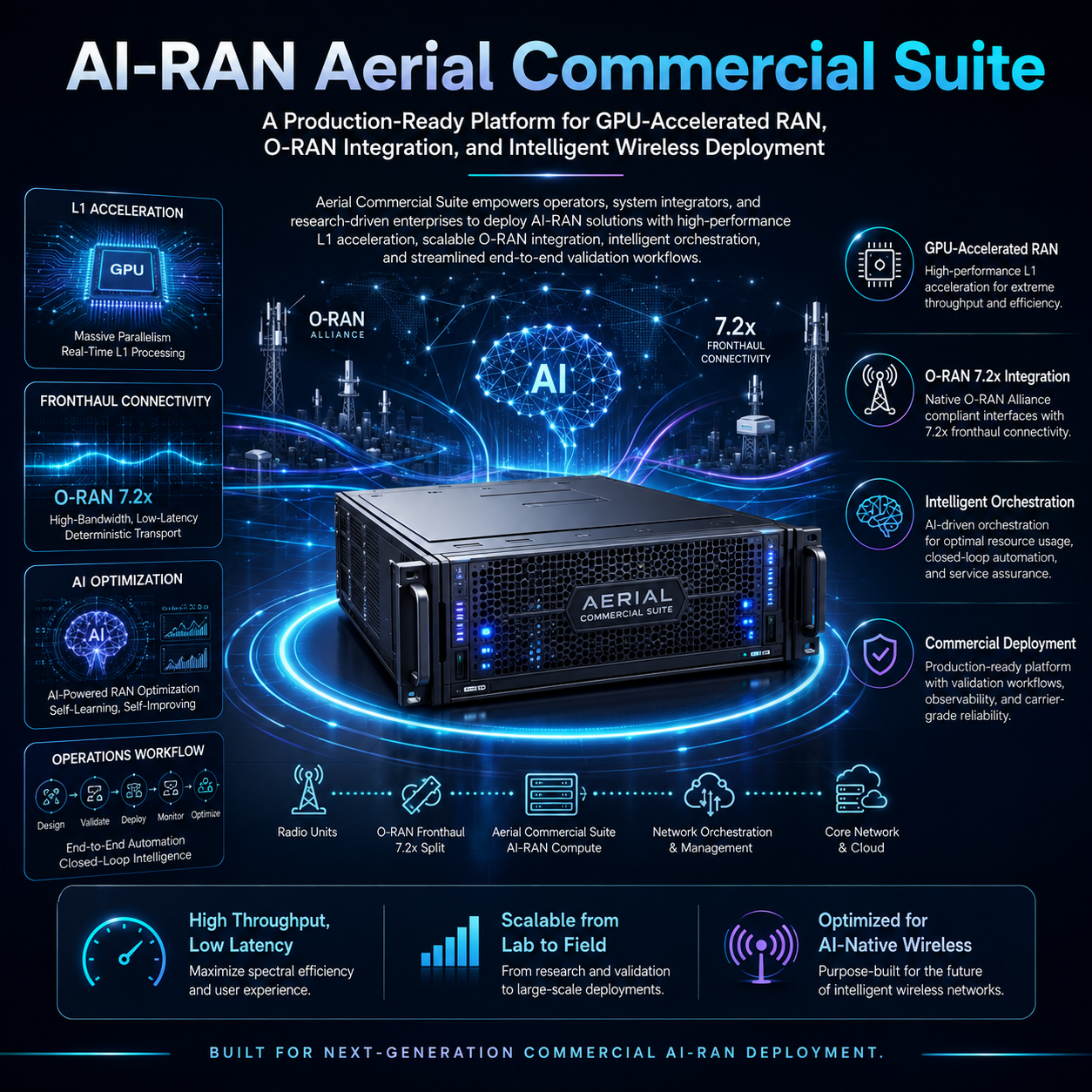
The AI-RAN Aerial Testbed Solution is a complete, GPU-accelerated 5G and AI-RAN development platform designed for universities, research institutes, mobile network operators, equipment vendors, and wireless engineering teams.
Based on the NVIDIA Aerial Testbed 1.0 architecture, the solution integrates NVIDIA Aerial CUDA-Accelerated RAN, OpenAirInterface, O-RAN-compliant radio units, precision timing equipment, fronthaul networking, a 5G Core Network, and commercial user equipment into a fully operational end-to-end wireless test environment.
The platform implements the O-DU Low physical layer on an NVIDIA GPU, while OpenAirInterface provides the O-DU High, O-CU, and 5G Core Network functions. It supports both over-the-air and RF-cabled operation and can interoperate with commercial O-RUs and 5G user devices through an O-RAN 7.2x fronthaul interface. (NVIDIA Docs)
The system is suitable for:
- 5G and 6G physical-layer research
- AI-RAN algorithm development
- O-RAN interoperability testing
- Neural receiver and AI-enhanced PHY research
- RAN scheduling and resource-allocation research
- Real-time wireless data collection
- Digital-twin-assisted network validation
- Commercial UE and O-RU integration
- End-to-end application and throughput testing
2. Reference System Architecture
The Aerial solution provides a complete end-to-end network chain:
Commercial UE → O-RU → O-RAN 7.2x Fronthaul → Fronthaul Switch → NVIDIA Aerial O-DU → OAI O-DU High/O-CU → 5G Core Network → Application Server
The reference architecture combines:
- NVIDIA GPU-accelerated Layer 1
- OpenAirInterface Layer 2 and Layer 3
- O-RAN Category A radio units
- Precision Time Protocol synchronization
- Commercial 5G smartphones or UE emulators
- Real-time RAN data acquisition
- AI/ML training and inference workflows
The O-RU connection uses Ethernet-based eCPRI transport over an O-RAN 7.2x interface, including Control Plane, User Plane, Synchronization Plane, and Management Plane support.
3. Hardware Configuration
3.1 AI-RAN DU/CU Computing Platform
Recommended Grace Hopper Configuration
Supermicro ARS-11GL-NHR Grace Hopper Server
| Component | Specification |
|---|---|
| CPU | 72-core NVIDIA Grace CPU |
| GPU | NVIDIA GH200 Grace Hopper Superchip |
| GPU Architecture | NVIDIA Hopper |
| System Memory | 480 GB LPDDR5X with ECC |
| GPU Memory | Up to 96 GB HBM3 |
| Network Interfaces | Two NVIDIA BlueField-3 DPUs/NICs |
| Storage | Enterprise NVMe SSD |
| Operating Architecture | ARM64 |
| Primary Role | O-DU Low, O-DU High, O-CU and optional 5G Core |
The Grace Hopper architecture provides a high-bandwidth coherent connection between the CPU and GPU, allowing Layer 1 workloads, Layer 2 processing, AI inference, and data acquisition to operate on a tightly integrated computing platform.
The official Aerial Testbed bill of materials specifies the Supermicro ARS-11GL-NHR with a 72-core Grace CPU, GH200 GPU, 480 GB ECC LPDDR5X memory, and two BlueField-3 network interfaces.
Compact Configuration
NVIDIA DGX Spark
| Component | Specification |
|---|---|
| CPU | 20-core ARM CPU |
| CPU Architecture | 10 Cortex-X925 cores and 10 Cortex-A725 cores |
| GPU | NVIDIA GB10 Blackwell architecture |
| Unified Memory | 128 GB |
| Network | Two QSFP interfaces based on ConnectX-7 |
| Primary Role | Compact single-cell Aerial Testbed |
Aerial Testbed 1.0 adds support for implementing an over-the-air testbed on DGX Spark. The reference release supports single-cell operation on this platform.
3.2 Fronthaul Network Switch
Recommended Model
Dell PowerSwitch S5248F-ON
The fronthaul switch provides deterministic, high-bandwidth connectivity among the NVIDIA computing platform, O-RU, and PTP Grandmaster.
Typical functions include:
- 25GbE O-RU fronthaul connectivity
- 100GbE or 200GbE server connectivity
- IEEE 1588v2 Precision Time Protocol
- VLAN-based fronthaul isolation
- Jumbo-frame transmission
- Low-latency Ethernet switching
- O-RAN synchronization-plane transport
Other switch platforms listed in the NVIDIA reference bill of materials include:
- NVIDIA Spectrum SN3750
- NVIDIA Spectrum SN5400
- Cisco Nexus 9300
- Ciena 5164
- ADVA XG480
- FibroLAN Falcon RX
3.3 PTP Grandmaster
VIAVI Qg 2 Multi-Sync Gateway
The VIAVI Qg 2 provides precision frequency and phase synchronization for the O-DU, fronthaul switch, and O-RU.
Primary functions include:
- IEEE 1588v2 PTP Grandmaster
- GNSS-referenced timing
- Frequency synchronization
- Phase and time synchronization
- Telecom timing profile support
- Synchronization monitoring
- Multi-device timing distribution
Accurate synchronization is essential for O-RAN 7.2x TDD operation, coordinated radio transmission, and deterministic fronthaul processing. The VIAVI Qg 2 is the Grandmaster identified in the official Aerial Testbed hardware list.
3.4 O-RAN Radio Unit
Reference O-RU
WNC 1220 4T4R Indoor O-RU
| Parameter | Specification |
|---|---|
| Radio Architecture | 4T4R |
| O-RAN Category | Category A |
| Functional Split | O-RAN 7.2x |
| Fronthaul Interface | 25GbE |
| Transport | Ethernet/eCPRI |
| Reference Frequency Range | 3.55–3.77 GHz |
| Deployment Type | Indoor |
| Synchronization | PTP over O-RAN S-Plane |
The platform may also be integrated with alternative n77, n78, n79 or other sub-6 GHz O-RUs, subject to band selection, firmware compatibility and O-RAN interoperability validation.
The official Aerial Testbed documentation identifies the WNC 1220 as the qualified 4T4R reference O-RU and lists n48 and n78 as tested sub-6 GHz reference bands for the platform.
3.5 5G User Equipment
Recommended commercial user equipment includes:
- Samsung Galaxy S22
- Samsung Galaxy S23
- Engineering 5G CPE
- Commercial 5G smartphones
- OAI GPU-accelerated Soft-UE
- External UE simulator
The Samsung Galaxy S22 and S23 reference devices support up to four downlink SU-MIMO layers and one uplink layer in the qualified Aerial Testbed configuration.
3.6 5G Core Network
The 5G Core Network may run:
- On the same Grace Hopper server as the gNB
- On a separate ARM-based server
- On a separate x86-based server
- In containerized or cloud-native form
Core functions include:
- Access and Mobility Management Function
- Session Management Function
- User Plane Function
- Authentication Server Function
- Unified Data Management
- Unified Data Repository
- Network Repository Function
The same Supermicro Grace Hopper server can host both the gNB and the Aerial Testbed 5G Core, although a separate Core Network server may be used when required.
3.7 Accessories
The complete solution normally includes:
- QSFP28 direct-attach cables
- 25GbE optical transceivers
- 10GbE optical transceivers
- LC-to-LC multimode optical cables
- Ethernet management cables
- RF attenuators and RF cables
- O-RU power supply
- Rack-mounted PDU
- GNSS antenna and timing cables
- SIM cards and programmable SIM profiles
- Management workstation
- Keyboard, mouse and display accessories
- Rack installation components
4. Software Stack
NVIDIA Aerial CUDA-Accelerated RAN
The GPU-accelerated Layer 1 stack provides:
- Downlink and uplink 5G NR physical-layer processing
- GPU-accelerated channel coding and decoding
- LDPC processing
- Polar-code processing
- FFT and IFFT processing
- Channel estimation
- Equalization
- Modulation and demodulation
- MIMO processing
- Beamforming
- PRACH processing
- PDSCH and PUSCH processing
- PDCCH and PUCCH processing
- O-RAN fronthaul processing
- FAPI-based Layer 1/Layer 2 integration
Aerial provides full inline acceleration of physical-layer functions and selected MAC functions on NVIDIA GPUs.
OpenAirInterface
OpenAirInterface provides:
- O-DU High
- MAC and RLC
- O-CU-CP
- O-CU-UP
- RRC and PDCP
- 5G Core Network
- Commercial UE registration
- PDU session establishment
- End-to-end IP connectivity
Containerized Deployment
The software stack can be delivered as validated containers for:
- NVIDIA Aerial Layer 1
- OAI gNB Layer 2 and Layer 3
- OAI 5G Core
- Network management
- Monitoring and logging
- Data Lake services
- AI/ML applications
5. Main Functions
5.1 End-to-End 5G Standalone Network
The system provides a complete 5G SA network from the radio interface to the Core Network. Commercial UEs can register with the network, establish PDU sessions and run bidirectional IP traffic.
Supported test modes include:
- Over-the-air testing
- RF-cabled testing
- Shielded-box testing
- UE-emulator testing
- O-RU-emulator testing
- Soft-UE testing
5.2 GPU-Accelerated Physical Layer
The complete 5G NR Layer 1 processing chain is executed inline on the NVIDIA GPU.
Benefits include:
- High-throughput signal processing
- Deterministic real-time execution
- Lower CPU processing requirements
- Scalable cell processing
- Direct integration of AI and RAN workloads
- Rapid implementation of custom PHY algorithms
5.3 O-RAN 7.2x Integration
The platform implements an O-RAN 7.2x fronthaul architecture between the O-DU and O-RU.
It supports:
- C-Plane transmission
- U-Plane transmission and reception
- S-Plane synchronization
- M-Plane radio management
- eCPRI encapsulation
- 25GbE O-RU connectivity
- Single-cell and multi-cell research
- Multi-vendor O-RU interoperability
The reference Category A split places precoding, digital beamforming, IFFT and cyclic-prefix insertion in the downlink low-PHY, and FFT, cyclic-prefix removal and digital beamforming in the uplink low-PHY.
5.4 AI-RAN Algorithm Development
Researchers can integrate AI models into different sections of the RAN protocol stack.
Typical research areas include:
- Neural channel estimation
- Neural receivers
- AI-based equalization
- Learned demodulation
- Link adaptation
- Intelligent scheduling
- Traffic prediction
- Energy optimization
- Interference management
- Beam selection
- Spectrum sensing
- Integrated sensing and communications
- Deep reinforcement learning for MAC scheduling
Because Aerial and OAI expose modifiable physical-layer and Layer 2 software, researchers can customize modulation, coding, signal-processing and scheduling algorithms.
5.5 Real-Time dApp Framework
Aerial Testbed 1.0 expands support for distributed applications, or dApps.
Applications may be developed using:
- Python
- C
- CUDA
- PyTorch
A dApp can subscribe to real-time RAN information such as:
- Fronthaul time-frequency resource-block I/Q samples
- Channel-state information
- PUSCH pipeline signals
- Channel estimates
- Layer 1 and Layer 2 metadata
This allows real-time AI inference for spectrum management, sensing, radio optimization and other AI-RAN functions.
5.6 Aerial Data Lake
The Aerial Data Lake enables synchronized capture of RAN data for offline analysis and real-time AI applications.
Supported data includes:
- Uplink fronthaul I/Q samples
- PUSCH data
- Channel estimates
- FAPI messages
- Layer 1 metadata
- Layer 2 scheduling information
- Downlink transport blocks
The captured data can be used for:
- AI/ML training dataset generation
- Neural-receiver development
- Troubleshooting
- RF-performance analysis
- Algorithm benchmarking
- Real-time dApp inference
The Data Lake provides time-coherent capture and database APIs for retrieving collected RAN data.
5.7 Digital Twin and Channel Emulator Integration
The platform can be connected to:
- NVIDIA Aerial Omniverse Digital Twin
- RF channel emulators
- Commercial UE emulators
- O-RU emulators
- Site-specific ray-tracing models
- Standardized 3GPP stochastic channel models
This enables repeatable validation under realistic propagation conditions before field deployment.
6. Performance
Reference OTA Performance
On a Grace Hopper-based Supermicro platform, previously published Aerial Testbed validation results include:
| Performance Item | Reference Result |
|---|---|
| Peak Downlink Throughput | Approximately 1.03 Gbps |
| Peak Uplink Throughput | Approximately 125 Mbps |
| Two-Cell Downlink Throughput | Approximately 700 Mbps per cell |
| Two-Cell Uplink Throughput | Approximately 105 Mbps per cell |
| Maximum Downlink MIMO Layers | Four layers |
| RF Channel Bandwidth | Up to 100 MHz, depending on configuration |
| Fronthaul Interface | 25GbE per reference O-RU |
| Functional Split | O-RAN 7.2x |
These throughput figures were published for the Supermicro Grace Hopper Aerial platform in NVIDIA’s earlier ARC-OTA validation results. Actual throughput depends on the O-RU, UE capability, frequency band, TDD pattern, MCS, RF conditions, software release and system configuration.
Aerial Platform Scalability
The qualified NVIDIA Aerial CUDA-Accelerated RAN platform supports:
- Up to 20 peak-load 4T4R cells on a Grace Hopper MGX system
- Up to 20 average-load 4T4R BFP9 cells
- 64T64R Massive MIMO
- 100 MHz channel bandwidth
- Up to 16 downlink and 8 uplink Massive-MIMO processing layers
- SRS-based beamforming
These figures represent Aerial CUDA-Accelerated RAN platform capacity and should not be interpreted as the default out-of-the-box capacity of every Aerial Testbed 1.0 OTA configuration.
7. Delivery Scope
A complete turnkey Aerial solution can include:
- All required AI-RAN computing hardware
- NVIDIA BlueField-3 networking
- O-RAN fronthaul switch
- PTP Grandmaster
- 4T4R O-RU
- Commercial 5G UE
- SIM cards
- Optical modules and cables
- NVIDIA Aerial software installation
- OpenAirInterface installation
- 5G Core Network deployment
- O-RU configuration
- Switch and PTP configuration
- End-to-end system integration
- OTA or RF-cabled validation
- Throughput testing
- System documentation
- Administrator and developer training
- Remote technical support
- Optional on-site installation
8. Key Advantages
Turnkey End-to-End Platform
The complete gNB, O-RAN fronthaul, O-RU, 5G Core and UE environment is integrated and validated before delivery.
GPU-Native RAN Architecture
Real-time physical-layer processing and AI workloads can operate on a common NVIDIA accelerated-computing platform.
Open and Programmable
The Aerial and OpenAirInterface software stacks allow researchers to inspect and modify PHY, MAC, scheduler and Core Network functions.
Commercial Hardware Interoperability
The system supports real O-RUs and commercial 5G user equipment instead of relying exclusively on simulation.
AI-Ready Data Pipeline
Aerial Data Lake and the dApp framework provide direct access to real-time wireless data for model training and inference.
Scalable from Research to Deployment
The architecture supports compact DGX Spark testbeds, full Grace Hopper research platforms, multi-cell validation and high-capacity AI-RAN development.
Product Summary
The AI-RAN Aerial Testbed Solution provides a production-relevant environment for developing, validating and demonstrating advanced 5G, O-RAN and AI-native wireless technologies. By combining NVIDIA GPU acceleration, an open software-defined RAN stack, commercial O-RAN radio units, precision synchronization and real-time wireless data acquisition, the platform shortens the path from simulation and algorithm development to live-network validation.

Reviews
There are no reviews yet.